
After my success in June, I decided it was time to stretch my wings a bit. Appleseed also offers a Rimfire Known Distance (RKD) Clinic, and this one was shot all the way out to 200 yards!
While a standard Appleseed focuses on the AQT (Army Qualification Test) simulated at 25 meters, the RKD event puts those fundamentals to the test on full-sized targets ranging from 50 to 200 yards. The primary goal here is to teach a shooter how to compensate for the external variables that just don’t exist at short range:
- Trajectory & Drop: Learning the specific “arc” of a .22 LR projectile.
- Windage: Understanding how even a light breeze can push a small rimfire bullet inches off-target at 100+ yards.
- DOPE (Data on Previous Engagement): Creating a personal reference chart for sight adjustments at specific distances.
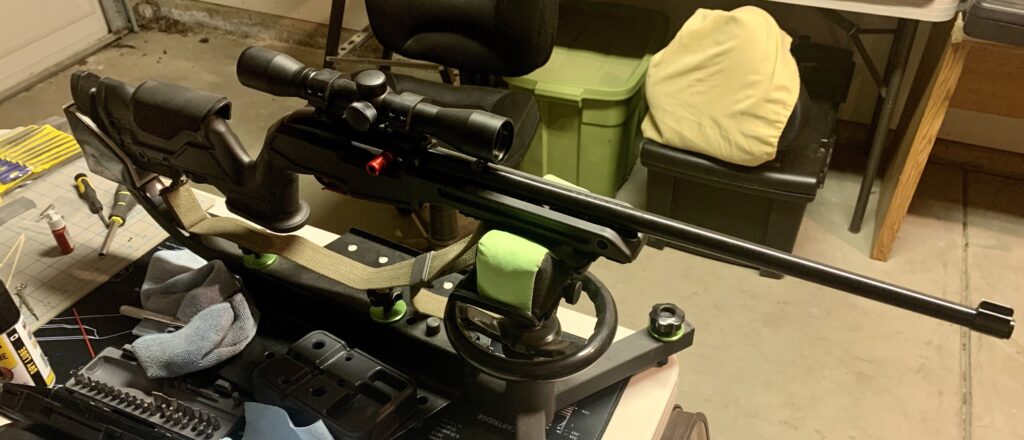
I decided to stick with what I know, so I brought out the same Archangel-stocked 10/22 and my trusty CCI SV ammunition. That meant another three-hour drive to the Sacramento Valley Shooting Center.
Saturday: The Gathering of Data
Saturday started much like the 25m clinic: the safety brief, the “Six Steps,” and reinforcing NPOA. We spent the day zeroing scopes and gathering data for the different ranges: 50, 100, 150, and 200 yards. Using the CCI SV, my drop at 200 yards was 29 MOA—that’s a staggering 58 inches! The day ended without us getting to a qualification. Some folks were still struggling to gather their DOPE, or simply didn’t have enough adjustment in their glass to reach 200 yards. I was still running the Vortex Crossfire 2-7, pushing it to its limits.
Sunday: The Wind Eats My Lunch
We arrived Sunday morning to a vast change in weather. It was colder and incredibly windy. After a quick recap to re-acquire our DOPE, we moved straight into the tests. The four stages of an RKD mirror the standard AQT, but with that “Known Distance” twist:
- Stage 1 (Standing/Offhand): 50 yards. 10 rounds in 2 minutes. At 50 yards, your “wobble zone” becomes very apparent.
- Stage 2 (Sitting/Kneeling): 100 yards. 10 rounds (2+8 mag change) in 55 seconds. You start standing, drop on the whistle, and fight the wind.
- Stage 3 (Prone Rapid): 150 yards. 10 rounds (2+8 mag change) in 65 seconds. A test of transitions and reading the gusts.
- Stage 4 (Prone Slow): 200 yards (simulating 400). 10 rounds in 5 minutes. Points are doubled here, making it worth 20 out of the 50 possible points.
Well, all I can say is I shot clean at 50 yards, and after that, the wind absolutely ate my lunch. I scored a 20. From there, the wind only got worse. On the left of the range, the flags showed a hard right-to-left, but just three targets over, they were pegged in the opposite direction! They say wind will tumble for seven times the distance of any obstruction, and we were shooting in a “bowl” surrounded by 20-25′ berms. It was total chaos.
Morgan’s Shingle
After lunch, they threw us a curveball; they set a target at 125 yds, a distance for which we didn’t have DOPE. The Target was about 3′ wide by 6″ high, and we had one cold bore shot to hit it. I guesstimated my drop at 1/3 of the adjustment needed for 150 yards, as drop increases faster with range. I took my shot, and I had my elevation perfect, hit mid-way up the shingles height, unfortunately, I missed about 3″ to the right.
The Results
We shot four tests over the weekend, and my scores were 20, 18, 26, and 25. I didn’t drop a single point at 50 yards, but at 200 yards, I was humbled: I scored 2 (1 hit), 0, 0, and 4 (2 hits).
The wind was brutal, and not a single soul made Rifleman all weekend. But as they say, a Rifleman perseveres—and on this occasion, I certainly needed to! Next Clinic is next April.
—EnglishBob