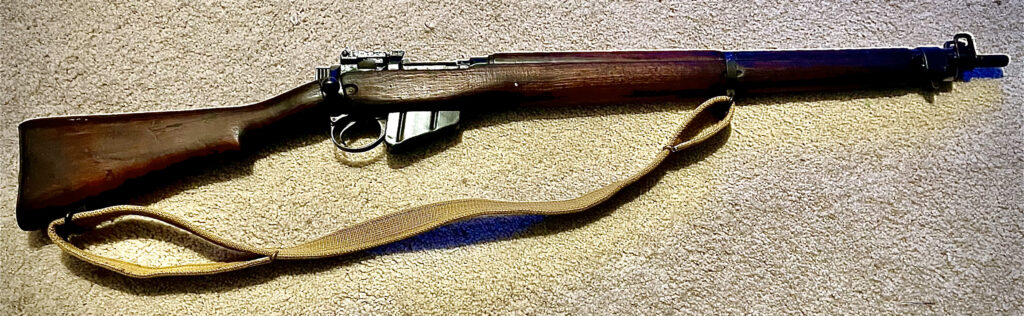
The Lee-Enfield .303 is more than just a rifle; for many, including me, it’s a piece of living history. Here is the breakdown of its legendary service life, its famous speed, and the American connection that likely produced my specific rifle.
1. Years of Service
The Lee-Enfield is one of the longest-serving military bolt-action rifles in history.
- Official Adoption: 1895 (replacing the Lee-Metford).
- Standard Issue: It was the primary infantry weapon for the British Empire and Commonwealth through both World Wars.
- Phase Out: It was officially replaced by the L1A1 Self-Loading Rifle (SLR) in 1957, though it remained in secondary service through the 1960s.
- Extended Life: The 7.62mm L42A1 sniper variant served until the 1990s. Even today, you’ll find them in the hands of the Canadian Rangers and various forces in the Middle East and Asia.
2. The “Mad Minute” (Rate of Fire)
The Lee-Enfield is famous for being the fastest bolt-action battle rifle ever fielded. This is due to its “cock-on-closing” action and a smooth, short bolt throw.
- Standard Rate: A well-trained soldier was expected to fire 15 aimed rounds per minute.
- The Mad Minute: Expert riflemen could achieve 20 to 30 aimed shots in 60 seconds at a 300-yard target.
- The Record: In 1914, Sergeant Instructor Alfred Snoxall set a world record by placing 38 rounds into a 12-inch target at 300 yards in one minute.
3. World War II Lend-Lease (The Savage Connection)
My Rifle — the 1943 No. 4 Mk I*—has a fascinating “born in the USA” backstory.
- The Need: After the evacuation at Dunkirk in 1940, the British Army had lost massive amounts of equipment. Their domestic factories couldn’t keep up with the demand for the new No. 4 rifle.
- The Contract: The British government turned to the US, eventually signing a contract with Savage Arms. Production took place at the Stevens Arms plant in Chicopee Falls, Massachusetts.
- Lend-Lease Act: While it started as a private contract, it was later folded into the Lend-Lease Act of 1941. This is why my rifle is stamped with “U.S. PROPERTY” on the receiver—a legal requirement for the US government to “lend” the rifles to the UK.
- The “*” (Star) Designation: The North American-built rifles (Savage and Long Branch in Canada) were designated Mk I* because they used a simplified bolt-release system to speed up wartime production. Instead of a spring-loaded plunger, they used a simple notch in the bolt rail.
4. The Variants
| Model | Common Name | Service Era | Key Features |
| Number 1 | SMLE (Short Magazine Lee-Enfield) | WWI & WWII | The iconic “Smelly.” Known for the blunt nose cap where the barrel is flush with the wood. Primarily used in WWI. |
| Number 2 | .22 Training Rifle | 1920s – 1950s | These were No. 1 Mk III rifles converted to fire .22 LR. This is likely very similar to what you shot as a young Cadet! |
| Number 3 | Pattern 14 (P14) | WWI & WWII | Technically not a “Lee” action. It used a Mauser-style bolt. It was highly accurate and often used by snipers, but lacked the fast “Mad Minute” bolt speed. |
| Number 4 | No. 4 Mk I / Mk I* | WWII – 1950s | Your 1943 Savage. Improved receiver-mounted peep sights and a heavier, more accurate barrel that protrudes past the woodwork. |
| Number 5 | Jungle Carbine | 1944 – 1947 | A shortened, lightened No. 4 with a conical flash hider and a rubber butt-pad. Designed for paratroopers and jungle warfare in the Pacific. |
| Feature | No. 1 Mk III (SMLE) | No. 4 Mk I / Mk I* |
| Era | Primarily WWI (used in WWII) | Primarily WWII |
| Sights | Barrel-mounted leaf sights | Receiver-mounted aperture (peep) sights |
| Barrel | Flush with the nose cap | Protrudes past the front |
| Bayonet | 17-inch Sword style | 8-inch “Pigsticker” Spike style |
5. Ammunition
The muzzle velocity of a .303 British round depends on the specific cartridge loading and the barrel length of the rifle, but for the standard military loads here are the numbers:
Standard Military Load (Mk VII)
The Mk VII was the most common round used through both World Wars and remains the “gold standard” for the Lee-Enfield No. 4.
- Muzzle Velocity: Approximately 2,440 ft/s (744 m/s).
- Bullet Weight: 174 grains.
- Effective Range: Out to 800 yards (though the sights on your No. 4 go up to 1,300 yards).
Modern Commercial Loads
If you are buying “off the shelf” ammo today (like Winchester, Remington, or PPU) for a range day:
- Muzzle Velocity: Usually ranges between 2,400 and 2,500 ft/s.
- Variation: Most modern hunting or target loads still stick close to the original military specifications to ensure the iron sights remain relatively accurate.
Why It Matters
The .303 was designed as a “black powder” era cartridge that successfully transitioned to smokeless powder. While 2,440 ft/s is slower than a modern .308 Winchester (which typically runs around 2,800 ft/s), the heavy 174-grain bullet carries significant momentum. This is why it earned a reputation for being an incredibly effective “stopping” round in both combat and big-game hunting.